
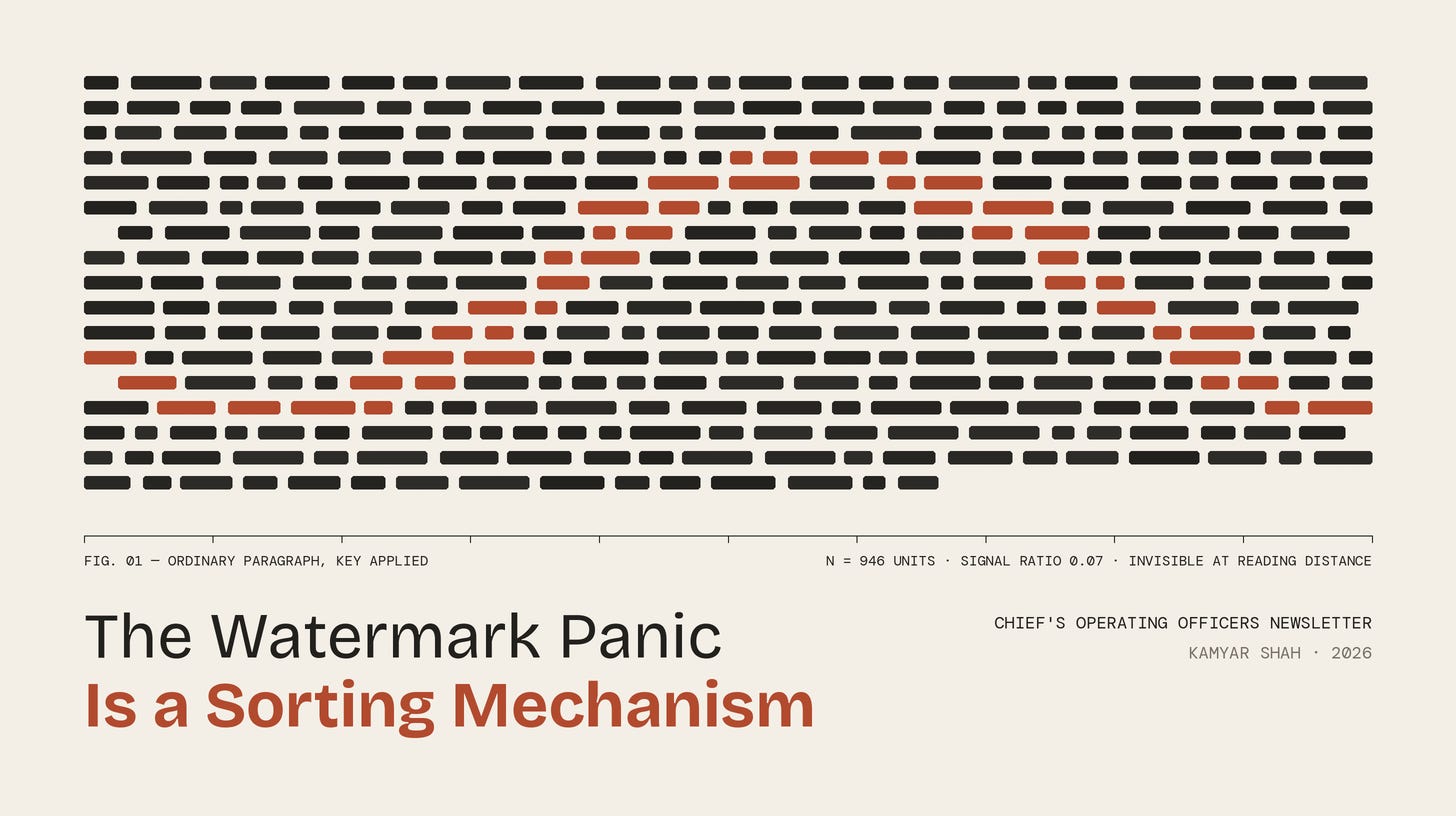
The complaints started within hours of the announcement. Anthropic confirmed on August 11 that Claude output now carries an invisible statistical watermark, an adaptation of the SynthID-Text method. The change satisfies the EU AI Act’s transparency rules, which took effect on August 2. The reaction across agencies and content shops was immediate: detection is coming, hide the tooling, protect the illusion.
That reaction is the real story. Not the watermark.
The Bottleneck Nobody Wants to Name
Most operators reading the watermark news are asking the wrong question. The question is not whether a buyer can detect AI in the workflow. The question is what the business model depends on, the buyer never finding out.
A firm that panics about provenance is confessing something about its pricing. It bills for labor, or for the appearance of labor, rather than for outcomes. When the deliverable is priced based on the hours it supposedly took, any tool that collapses those hours threatens the invoice. That is not a technology problem: it is a pricing architecture problem wearing a technology costume.
The Anti-Pattern: Hiding the Machinery
Watch what the panicked shops are doing right now. Paraphrase pipelines to degrade the watermark. Migrations to weaker open models are chosen for invisibility rather than quality. Entire workflows are rebuilt around concealment instead of output.
Every hour spent disguising the toolchain is pure waste. It adds no value to the client, improves no deliverables, and compounds nothing. It exists only to preserve a story that the pricing model cannot survive without. Firms that build systems around concealment are building on a foundation that regulation, platform policy, and buyer sophistication are all eroding at once.
Do Not Panic. Diagnose.
Detection only matters where two conditions meet: someone holds the means to check, and someone has a reason to check. Anthropic’s watermark requires a decoding key. It is not a public scanner, and it does not announce itself to readers. The exposure is narrow, specific, and mostly concentrated in markets that pay a premium for verified human authorship.
So the diagnostic question for any operator is simple. Does the revenue depend on what the work costs to produce, or on what the work produces? Answer that honestly before touching a single workflow.
One clarification before going further, because two very different objections are being shouted in the same thread. Operators who openly disclose their use of AI still have a fair commercial grievance here. A vendor embedding an invisible signature into paid output, without matching detection tooling or pricing consideration, is running a one-sided trade that deserves to be pressed. The panic this article dissects is the other objection, the scramble to hide the toolchain, and the two should never be confused.
The Framework: Signaling Theory, Inverted
Michael Spence’s signaling theory, the 1973 work that later earned a Nobel Prize, explains how markets read signals when direct quality is hard to observe. Buyers infer competence from proxies. For decades, “human-made” was the proxy for quality in professional services.
That signal has inverted, and the suspicious reading now runs the other direction. In 2026, a provenance mark that says advanced tooling touched the work reads about as scandalous as detecting that the office has electricity. A firm whose output shows zero modern tooling is either spending margin to hide it or spending margin to avoid it. Both choices tell a buyer something, and neither one is flattering.
The practical audit takes three steps. First, classify every revenue line as labor-priced or outcome-priced. Second, for each labor-priced line, ask whether the buyer is paying for verified human authorship or simply assuming it. Third, migrate everything that fails the test to value-based pricing, where the fee is tied to the result and the toolchain becomes an internal efficiency decision rather than a secret.
What This Protects
The point of this restructuring is not to win an argument about AI. It is to protect the people doing the work. A team forced to disguise its methods operates under a standing threat: one detection event, one policy change, one sophisticated client, and the story collapses.
A team priced on outcomes carries no such fragility. Its members are free to use the strongest available tools, document their processes openly, and compound their skills instead of their cover stories. Structure is what protects human capital from that kind of chaos. The firms that internalize this will keep their best people, and the firms that do not will exhaust them.
The Pattern in Practice
Consider a mid-market marketing services firm that repriced its retainers around deliverable outcomes, published traffic and pipeline targets, rather than hours. When clients asked about AI in the workflow, the firm answered plainly: every capable tool available, applied by senior operators. Not one client left over the disclosure. Several cited it as the reason they signed, because a vendor confident enough to show its methods is one with nothing structural to hide.
Contrast that with shops still selling “hand-crafted” content at hand-crafted prices. Their margin depends on an information gap that watermarking, EU transparency law, and buyer education are closing from three directions at once. The same obligations that apply to Anthropic also apply to OpenAI and Google, so this is not one vendor’s policy. It is the new floor.
The Closing Observation
Regulation just built a sorting mechanism into the market, and it sorts on something more durable than tooling. It depends on whether a firm’s economics can survive the truth about how the work gets done.
The watermark itself is almost beside the point. Any business that functions only when its methods remain hidden already carries a structural defect, and every such defect is eventually priced in. Build the systems, price the outcomes, and let the tools be visible. What a firm is willing to show is a reasonable measure of what it has actually built.